The transition from high school to undergraduate humanities often feels like moving from a paved road into a dense forest. In STEM subjects, there is usually a formula to follow or a “right” answer to find. In the humanities—history, philosophy, literature, and sociology—the “answer” is a subjective argument that you must build from the ground up using nothing but logic and evidence. This shift in expectations is where most students find themselves stuck, often staring at a blank screen wondering how to turn a pile of notes into a persuasive narrative that satisfies a professor’s rubric.
Understanding the internal logic of an essay is the first hurdle for any student. It isn’t just about having good grammar or a wide vocabulary; it’s about the architecture of your thoughts. Many students fall into the trap of summarizing a plot or a sequence of events rather than analyzing why those events matter. This is why seeking professional essay help online has become a common strategy for undergraduates who need to see how a professional argument is structured before they can replicate it themselves. By observing how experts transition from a thesis statement to supporting evidence, students can bridge the gap between “telling” and “arguing,” ensuring their work meets the analytical standards of higher education.
The Fundamental Shift: From Summary to Analysis
The biggest struggle for humanities students is the “So What?” factor. You might present a perfectly accurate fact, but if you don’t explain its significance to your overall thesis, the fact sits there like a brick without mortar. In a 2026 academic environment, where information is everywhere, your value as a writer comes from your ability to synthesize that information into something new.
Why Analysis is Harder than Memorization:
- Ambiguity: There are rarely black-and-white answers in human history or culture.
- Nuance: You must acknowledge counter-arguments without weakening your own position.
- Synthesis: You have to combine different theories to create a unique perspective.
| Feature | High School Level | Undergraduate Level |
| Primary Goal | Demonstrate knowledge of facts | Construct an original argument |
| Source Usage | Quoting to prove a point | Interrogating the source’s bias |
| Structure | The 5-paragraph essay | Fluid, thematic organization |
| Evidence | Direct evidence only | Direct and circumstantial |
The Burden of Historical Evidence
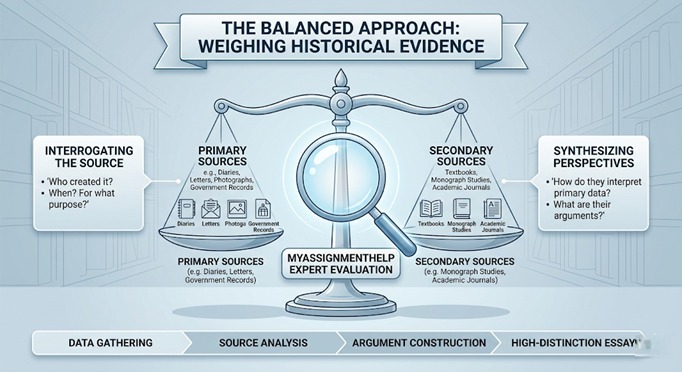
When we move specifically into history, the challenges multiply. History isn’t just a list of dates; it is an interpretation of the past based on fragmented, often biased evidence. Students often struggle because they treat historical documents as “the truth” rather than as a specific perspective colored by the era’s politics and social norms.
Writing a history paper requires you to be a detective. You have to look at the silences in the archives—what wasn’t said is often as important as what was recorded. For those struggling to balance multiple primary sources while maintaining a clear chronological flow, specialized history essay help from a dedicated team like MyAssignmentHelp can provide the necessary clarity. This type of focused support helps students understand how to weigh a 19th-century diary entry against a 21st-century statistical report, ensuring the evidence actually supports the claims being made rather than just filling space.
The Logical Loop: How to Build an Argument
To rank well in your professor’s eyes (and on the page), you need to follow a logical loop. Every paragraph should serve the thesis. A common mistake is “data dumping,” where a student provides three quotes in a row without explaining how they connect.
- The Claim: State a point that supports your thesis.
- The Evidence: Provide a quote, a data point, or a historical fact.
- The Warrant: Explain how this evidence proves your claim.
- The Pivot: Connect this point to the next paragraph to maintain “flow.”
Most students stop at step two. In the humanities, the explanation (the warrant) is where the actual “writing” happens. This is the part that demonstrates your critical thinking skills and separates an “A” paper from a “C” paper.
The Role of Information Gain in Modern Writing
In today’s academic environment, simply repeating what is in the textbook isn’t enough. To stand out, you need to provide “Information Gain.” This is a concept used by search engines to rank content, but professors use a similar metric. They are looking for a unique angle—perhaps a local perspective on a global event or a modern sociological lens applied to an ancient text.
To achieve this, you must move beyond the first page of search results. Visit the library, access JSTOR, and look for “niche” scholarship. When your essay includes a perspective that the professor hasn’t read twenty times already that day, your grade naturally climbs because you are contributing to the academic conversation rather than just echoing it.
Avoiding the “Spammy” Writing Trap
Whether you are writing for a blog or an academic journal, “spammy” writing is characterized by fluff—words that take up space without adding value. Undergraduates often use “filler” phrases like “It is important to note that…” or “Throughout the history of mankind…” to reach a word count. This actually hurts your readability and makes your argument feel weak.
Human-centric writing is lean. It values clarity over complexity. Use active verbs. Instead of saying “The treaty was signed by the leaders,” say “Leaders signed the treaty, ending a decade of tension.” This makes your writing more readable and authoritative. It also helps you stay within word counts while maximizing the impact of every sentence.
Conclusion: Embracing the Complexity
The humanities are difficult because they reflect the complexity of the human experience. There are no shortcuts to deep thinking, but there are frameworks you can use to make that thinking visible on the page. By focusing on essay logic, treating evidence with skepticism, and seeking help when the workload becomes overwhelming, you can master the art of the academic argument. Remember, a great essay isn’t just about what you know; it’s about how you prove what you know.
Frequently Asked Questions (FAQ)
Q1: How do I know if my essay is too descriptive?
Ans: If most of your sentences start with “The author says…” or “The event happened in…”, you are likely describing. If your sentences start with “This suggests…” or “The implication of this is…”, you are analyzing.
Q2: What is the best way to organize a history essay?
Ans: While chronology is important, thematic organization is often better. Instead of writing about “1914, then 1915, then 1916,” write about “Economic causes, then Political causes, then Social causes.”
Q3: How long should my paragraphs be?
Ans: In undergraduate writing, aim for 150-250 words per paragraph. Anything shorter feels “choppy” for a deep analysis, and anything longer becomes a “wall of text” that is hard to read.
Q4: Can I use “I” in a humanities essay?
Ans: This depends on your department’s style guide. However, it is generally better to let your argument speak for itself. Instead of saying “I believe the treaty failed,” say “The treaty’s failure is evident in the subsequent economic collapse.”
Q5: How do I avoid plagiarism while using essay help?
Ans: Use professional services as a learning tool. Read the provided model to understand the structure, the sources used, and the style of argument, then use those insights to write your own original work.
About The Author
I am Ruby Walker, a digital strategist and academic consultant at MyAssignmentHelp. With a deep background in curriculum development and SEO content strategy, I focus on bridging the gap between student struggle and academic success.